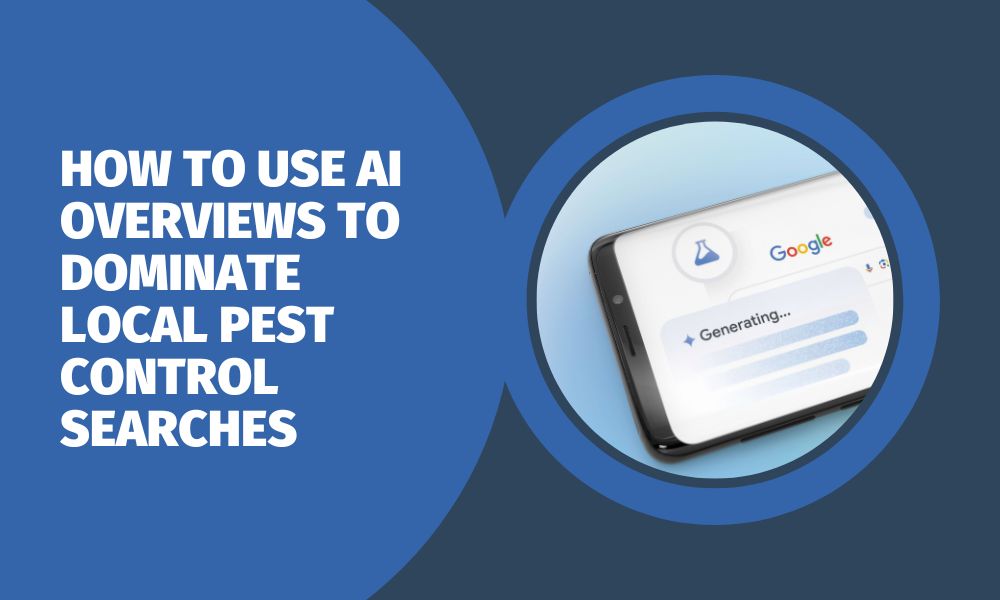
AI Overviews are one of the biggest changes Google has made to search in years. These automatically generated summaries sit at the top of many search results and provide users with consolidated answers drawn from multiple trusted sources.
For pest control companies, this shift represents both a challenge and an opportunity. Businesses that understand how AI Overviews work can position themselves as primary sources of information, win more visibility, and capture high-intent customers earlier in the search journey. Those who ignore it risk losing clicks, authority, and local relevance.
This guide breaks down how AI Overviews evaluate content and how pest control companies can adapt their SEO and content strategy to build the authority needed to rank inside these new AI-driven summaries.
AI Overviews Represent a New Layer of Competition
Unlike traditional organic results, AI Overviews function as a direct answer engine. Instead of displaying links and snippets alone, Google synthesizes information and presents homeowners with a unified explanation or recommendation.
For searches like “how to get rid of ants,” “signs of termites,” “who provides pest control near me,” or “how often should I spray for bugs in [city],” Google is now providing its own curated summary before users scroll to traditional results.
For pest control companies, this means attention is no longer guaranteed—even if you rank well organically. If your content isn’t included in the AI-generated explanation, you may lose visibility to competitors who are better optimized for this new format. Understanding this shift is the first step toward adjusting your digital strategy.
AI Overviews Prefer Expertise, Not Keyword Tricks
Google no longer rewards pages that simply match keywords. AI Overviews pull from content that demonstrates genuine expertise: pages that clearly explain processes, answer questions, define concepts, and provide helpful, actionable information. This aligns with Google’s focus on E-E-A-T (Experience, Expertise, Authority, Trust).
For pest control companies, this means thin service pages, generic blog posts, or “keyword-heavy but shallow” articles will not earn placement in AI Overviews.
Instead, Google is looking for content that reflects real professional experience—explanations of how treatments work, what homeowners should expect, what signs indicate pest activity, and when to call a professional. The more your content educates instead of sells, the more likely Google is to rely on it.
Answering Real Pest Control Questions Is the New SEO Advantage
Traditional SEO focuses on ranking for service keywords like “pest control near me” or “rodent exterminator.” AI Overviews place higher value on content that answers the underlying questions customers are asking. This includes how-to guidance, identification tips, timelines, treatment expectations, and prevention advice.
For example, instead of saying “We offer ant control,” your content should explain how ant behavior changes seasonally, why certain treatments fail, and what homeowners can do before technicians arrive. AI models favor information that meaningfully helps the user, not promotional language.
The more complete and educational your explanations, the more likely your company will be used as a trusted source.
Question-Based Structure Helps AI Understand Your Content
AI Overviews respond particularly well to content that mirrors natural language queries. Even though you are shifting toward more paragraph-heavy writing, structuring pages around clear questions still helps AI recognize the intent of your content.
This means integrating headings such as:
- “How long does professional ant treatment take?”
- “What are the signs of rodent activity in a home?”
- “How often should homes be treated for pests in [city]?”
Instead of answering these with a sentence or two, the goal is to provide thorough, complete explanations. This approach allows Google’s AI systems to easily extract your insights and include them in its summaries. It also elevates your topical authority on specific pests, treatments, and local conditions.
Localization Plays a Major Role in AI Visibility
One of the strongest signals AI uses to choose sources is local relevance. Pest behavior, seasonality, and treatment expectations vary by region, and AI Overviews prioritize content that reflects local context. This is why creating city-specific pages and locally-informed articles can give you a significant advantage.
For example, content explaining how temperatures in your area drive seasonal infestations establishes your company as a geographically specific expert—not a generic national source. AI models recognize this nuance, especially when multiple pages consistently demonstrate expertise tied to your service region.
The more your content reflects local pests, climate patterns, regulations, and treatment considerations, the more AI trusts you as a regional authority.
Building Topical Clusters Helps You Become a Recognized Expert
AI systems prefer websites that go deep on a subject rather than touching it once. A topic like “rodent control” is not just one page—it can be an entire cluster: identification, entry points, prevention, trapping, sanitation, exclusion, seasonal changes, treatment timelines, long-term strategies, and more. When Google sees a library of connected content around a theme, it recognizes your business as a topical expert.
For pest control marketing, this approach works well across categories such as termites, rodents, ants, bed bugs, mosquitoes, and wildlife. A cluster-based strategy demonstrates breadth and depth, increasing the likelihood that AI will pull from your site when generating an overview.
E-E-A-T Signals Strengthen Credibility With AI
Google’s AI models are trained to favor content that is factually reliable, locally accurate, and clearly written by real professionals. To reinforce this, your website should include visible indicators of trust: technician bios, photos, licensing details, review ratings, guarantees, and clear service explanations. These elements reinforce that your content is coming from a legitimate, experienced service provider—not a generic affiliate blog or content farm.
Even subtle improvements, such as adding a byline (“Content reviewed by [Your Company] Lead Technician”) or incorporating field-based insights, help establish legitimacy. AI Overviews reward content that feels grounded in practical experience.
Your Google Business Profile Directly Influences AI Overviews
AI Overviews frequently reference the information contained in your Google Business Profile (GMB): ratings, reviews, hours, services, coverage areas, and general business details. A complete profile not only improves traditional local SEO but also ensures that Google’s AI models have accurate, up-to-date information when pulling into summaries.
Consistent review activity, expanded services, and fresh content on your GMB all contribute to better visibility. Since many pest control queries include local intent (“near me,” “in my area”), Google’s systems lean heavily on GMB data when constructing recommendations.
Consistency Across All Platforms Supports AI Confidence
One of the factors that reduces visibility in AI Overviews is inconsistent information. If your website lists one set of service areas, your directory listings list another, and your GMB lists something else entirely, Google becomes less confident in your data. AI systems prioritize sources that demonstrate stability and accuracy across platforms.
This means ensuring uniformity in your service areas, business description, phone numbers, hours, and pricing or starting rates. The more consistently your digital footprint presents your company, the more likely AI is to rely on your information.
Conclusion
AI Overviews are reshaping how homeowners find and evaluate pest control companies. While many businesses are focusing solely on traditional SEO, those who recognize the shift toward AI-driven visibility will gain a competitive advantage.
By producing high-quality, expert-level explanations, structuring content around real questions, building local authority, and maintaining consistent data across platforms, pest control companies can position themselves as trusted sources that appear inside these highly visible summaries.
This shift rewards companies that genuinely help customers understand pests, treatments, and expectations—not those who rely on outdated keyword tactics. The more your content reflects expertise and clarity, the more AI Overviews will favor your business.